The Villanova or Villanovian culture (900-700 BC) is the term used by archaeologists to designate the earliest Iron Age culture of Central and Northern Italy, which represents the oldest phase of Etruscan civilization, derived from the Protovillanovan culture of the late Bronze Age.
The name Villanovan of the early phases of the Etruscan civilization comes from the place of the first archaeological discoveries relating to this advanced culture, remnants of a cemetery found near Villanova, (8 kilometers south-east of Bologna) in northern Italy. The excavation lasting from 1853 to 1855 was made by the Italian archeologist, Giovanni Gozzadini, who was also the owner of that property, and involved 193 tombs, six of which were separated from the rest as if to signify a special social status.
The "well tomb" pit graves lined with stones contained funerary urns; they had been only sporadically plundered, and most were untouched. In 1893, a chance discovery unearthed another distinctive Villanovan necropolis at Verucchio, overlooking the Adriatic coastal plain.
The burial characteristics relate the Villanovan culture to the Central European Urnfield culture (c. 1300–750 BC), and Celtic Hallstatt culture (which succeeded the Urnfield culture), in such a way that it is not possible to tell them apart in their earlier stages. Cremated remains were placed in cinerary urns, specifically in biconical urns and then buried.
The Villanovan culture is divided into Villanovian I from 900 BC to around 800 BC, and the Villanovian II from 800 BC about 720 BC. The Villanovian II phase sees radical changes, evidence of contact with Hellenic civilization and trade with the north along the Amber road.
The material basis of the Villanova culture was based on agriculture and livestock. In addition, the production of ceramics and the production of iron tools and weapons were of great importance. The social structure of early Villanova culture was probably still underdeveloped.
At sites from later times, however, there are features of stronger hierarchization, which can be seen from the spatial structure of the settlements and the arrangement of graves. On the basis of iron smelting and intensive trade in iron, proto-urban settlements with aristocratic leaders emerged.
Housing was rectangular in shape. The people lived in small huts, made of wattle and daub with wooden poles for support. Within the huts, contained cooking stands, utensils and charred animal bones indicate the family life of early inhabitants in Italy.
The period of the transition from the Villanova culture to the Etruscans (late 8th to early 6th century BC) is referred to in Italian prehistoric research as Periodo Orientalizzante (orientalizing period), because due to immigration movements and trade relations in this period increased cultural Influences from the Near Eastern region, which among other things led to the emergence of a local script and coinage.
The "nuclear family" replaces the agrarian community of the previous period, which corresponds to the establishment of the power of a pater familias. From now on, the inheritance is carried out within the same family and the heritage itself becomes hereditary. This change in turn determines the implementation of a new social system that replaces the archaic Villanovan society.
In the last Villanovan phase, (about 770–730 BC), the Etruscans established relations of a certain consistency with the first Greek immigrants in southern Italy, and with Phoenicians, who settled in south-west Sardinia. The earliest Etruscan inscriptions date back to around 700 BC, when the first inscriptions are attested in southern Etruria.
The very first human habitation in the Japanese archipelago has been traced to Paleolithic period around 35,000 BC.
During much of this period, Japan was connected to the Asian continent by land bridges due to lower sea levels, via Sakhalin Island in the north and via the Ryukyu Islands and Taiwan in the south. Also, the Korea Strait was quite narrow at the Last Glacial Maximum from 25,000 to 20,000 years BC.
Radiocarbon dating has shown that the earliest fossils in Japan date back to around 32,000–27,000 years ago; for example in the case of Yamashita Cave c. 32,000 BC, in Sakitari Cave c. 30,000 BC, in Shiraho Saonetabaru Cave c. 27,000 BC among others.
The study of the Japanese Paleolithic period is characterized by a high level of stratigraphic information due to the volcanic nature of the archipelago: large eruptions tend to cover the islands with levels of Volcanic ash, which are easily datable and can be found throughout the country as a reference.
The Japanese Paleolithic is unique in that it incorporates one of the earliest known sets of ground stone and polished stone tools in the world. The tools, which have been dated to around 30,000 BC, are a technology associated in the rest of the world with the beginning of the Neolithic around 10,000 BC. It is not known why such tools were created so early in Japan.
The Paleolithic populations of Japan, as well as the later Jōmon populations, appear to relate to an ancient Paleo-Asian group which occupied large parts of Asia before the expansion of the populations characteristic of today's people of China, Korea, and Japan.
Skeletal characteristics point to many similarities with other aboriginal people of the Asian continent. Dental structures belong to the Sundadont group, mainly distributed in ancient populations of South-East Asia.
The period of Japanese prehistory that spans from about 12,000 BC to about 1,000 BC is known as The Jōmon period. In this time Japan was inhabited by a hunter-gatherer culture that reached a considerable degree of sedentism and cultural complexity. The name Jōmon is the Japanese translation for "cord-marked" pottery, which was typical for that time. The pottery style characteristic of the first phases of Jōmon culture was decorated by impressing cords into the surface of wet clay and is generally accepted to be among the oldest in East Asia and the world.
The earliest pottery in Japan was made at or before the start of the Incipient Jōmon period. Small fragments, dated to 14,500 BC, were found at the Odai Yamamoto I site in 1998.
The Early and Middle Jōmon periods saw an explosion in population, as indicated by the number of settlements from this period. This occurred during the Holocene climatic optimum (between 4000 and 2000 BC), when the local climate became more humid.
The Jōmon period was rich in tools and jewellery made from bone, stone, shell and antler; pottery figurines and vessels; and lacquerware. There is evidence that the Jōmon people built ships out of big trees and used them for fishing and traveling. There is no agreement if they used sails or paddles.
The degree to which horticulture or small-scale agriculture was practiced by Jōmon people is debated. The hunter-gatherer conceptualization of the Jōmon period culture is part of scientific romanticized narratives. There is evidence to suggest that arboriculture was practiced, which place them somewhere in between hunting-gathering and agriculture.
Some elements of modern Japanese culture may had come from Jomon groups. Among these elements are the precursors to Shinto, some marriage customs, some architectural styles, and possibly some technological developments such as lacquerware, laminated yumi, metalworking, and glass making.
At the end of the Jōmon period the local population declined sharply. Scientists suggest that this was possibly caused because of food shortages and other environmental problems.
Between 1,000 and 800 BC the Yayoi people, an ancient ethnic group, migrated to the Japanese archipelago from the Asian continent. They interacted and mixed with the Jōmon people to form the modern Japanese people.
The period between 1,000 BC and 300 AD is known as The Yayoi period, and it covers the Neolithic and the Bronze Age in Japan. Distinguishing characteristics of the Yayoi period include the appearance of new Yayoi pottery styles and the start of an intensive rice agriculture in paddy fields. A hierarchical social class structure dates from this period and has its origin in China. Techniques in metallurgy based on the use of bronze and iron were also introduced from China over Korea to Japan in this period.
They wove textiles, lived in permanent farming villages, and constructed buildings with wood and stone. They also accumulated wealth through land ownership and the storage of grain. Such factors promoted the development of distinct social classes.
The earliest written records about people in Japan are from Chinese sources from this period. Wo, the pronunciation of an early Chinese name for Japan, was mentioned in 57 AD. Early Chinese historians described Wo as a land of hundreds of scattered tribal communities.
The population of Japan began to increase rapidly, reaching between 1.5 to 4.5 million by the end of the Yayoi period. The Yayoi tribes gradually coalesced into a number of kingdoms.
During the subsequent Kofun period, most of Japan gradually unified under a single kingdom. The symbol of the growing power of Japan's new leaders was the kofun burial mounds they constructed from around 250 AD. The center of the unified state was Yamato in the Kinai region of central Japan. The rulers of the Yamato state were a hereditary line of Emperors who still reign as the world's longest dynasty. Starting with this period begins the recorded history of Japan.
The Seine-Oise-Marne culture is the name given by archaeologists to the final culture of the Neolithic and first culture of the Chalcolithic in northern France and southern Belgium. The Seine-Oise-Marne culture has been named because of the numerous archaeological discoveries made in the Seine, Oise and Marne basins. but this crop has spread far beyond, throughout northwestern France and southern Belgium.
It lasted from around 3100 to 2000 BC and is most famous for its gallery grave megalithic tombs which incorporate a port-hole slab separating the entrance from the main burial chamber. In the chalk valley of the River Marne rock-cut tombs were dug to a similar design. Some have examples of megalithic art with images of axes, breasts and necklaces carved on their walls.
The culture of Seine-Oise-Marne is characterized by the use of a thick pottery, rather coarse style, whose typical shape is called "pot-de-fleur" because of its resemblance with this contemporary object. This ceramic is poorly decorated, the patterns being limited to incisions or patterns scored by printing.
Diagnostic artefacts include transverse arrowheads, antler sleeves and crude, flat-based cylindrical and bucket-shaped pottery decorated with appliqué cordons. The Seine-Oise-Marne culture had trade links with neighbouring cultures enabling the use of Callaïs and Grand Pressingy flint imported from Brittany and the Loire and later, the use of copper.
The trepanation was widespread in the Paris Basin. Treated skulls were found in almost all of Allées couvertes, and many bones were found among the burial objects. Even more mysterious than the skull bore are T-shaped signs, which were dug into a number of female skulls during their lifetime. They resemble the double ax shown in a rock tomb on the Marne.
The culture seems to have had strong links with other areas and may have arisen from a composite of influences as indicated by the gallery grave design common across Europe and the pottery types which have comparators in Western France from 2600 BC and also in Brittany, Switzerland and Denmark.
The Seine-Oise-Marne culture is contemporary with the culture of corded ceramics stretching from the East of France to Russia, with which it shares enough common cultural elements so that we can consider the first as a subset of the second.
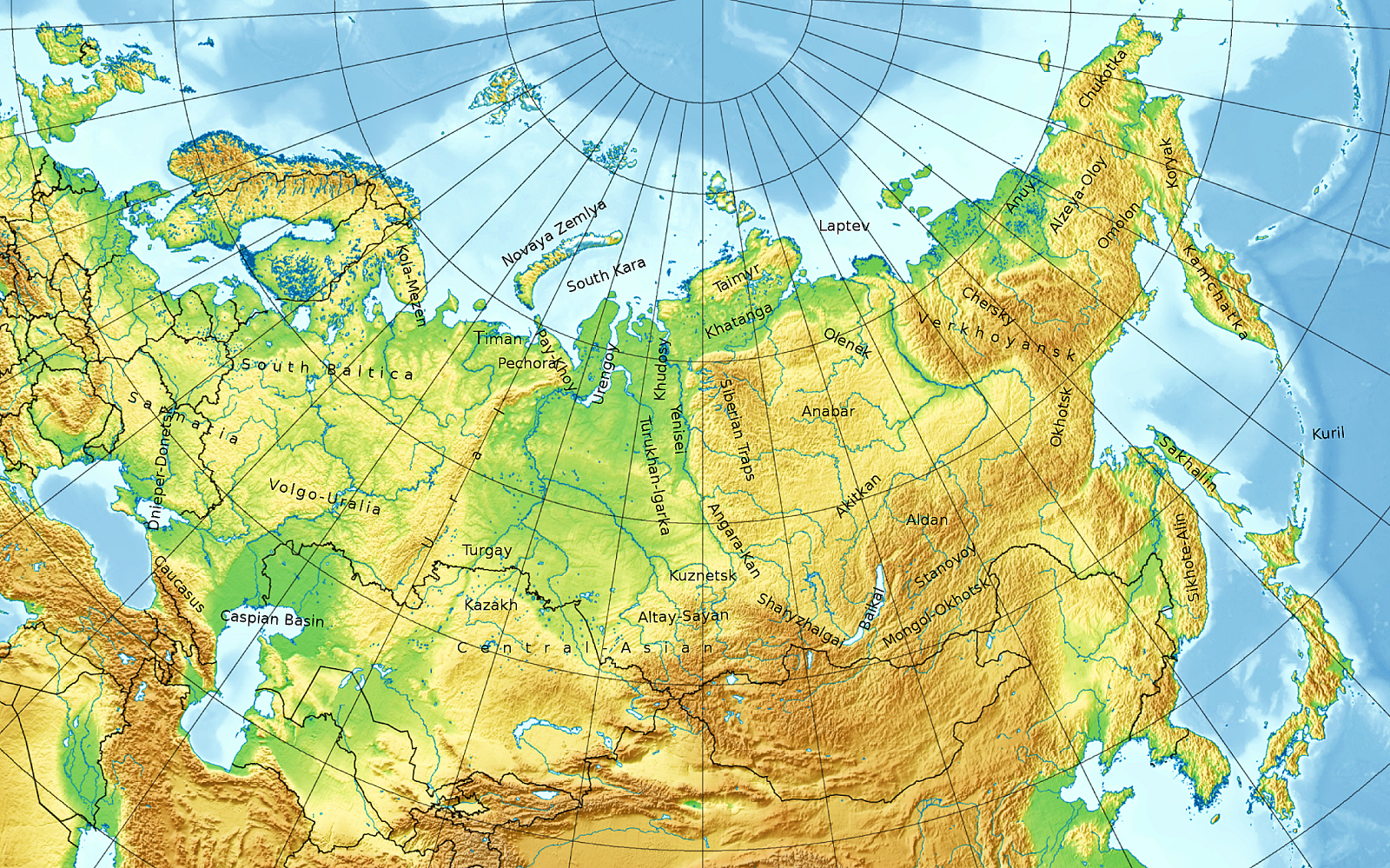
Siberia is characterised by a great deal of variety in climate, vegetation, and landscape. In the west, Siberia is bordered by the Ural Mountains. From there, the west Siberian lowlands extend to the east, all the way to the river Yenisei. Beyond this are the central Siberian highlands which are bordered on the east by the basin of the Lena River, beyond that are the northeast Siberian highlands. Siberia is bordered on the south by a rough chain of mountains and to the southwest by the hills of the Kazakh border.
The climate in Siberia is very variable. Yakutia, northeast of the Lena, is among the coldest places on Earth, but every year temperatures may vary for more than 50 °C, from as low as −50 °C in winter to over +20 °C in summer. The rainfall is very low. This is true of the southwest as well, where steppes, deserts and semi-deserts border on one another.
Agriculture is only possible in Siberia without artificial irrigation today between 50° and 60° north. The climatic situation is responsible for the different biomes of the region. In the northernmost section, there is tundra with minimal vegetation. The largest part of Siberia, aside from the mountainous regions, is taiga, northern coniferous forests. In the southwest this becomes forested steppe, and even further south it transitions to grass steppes and the central Asian desert.
Finds from the Lower Paleolithic appear to be attested between east Kazakhstan and Altai. In the Upper Palaeolithic, by contrast, most remains are found in the Urals, where, among other things, rock carvings depicting mammoths are found, in Altai, on the upper Yenissei, west of Lake Baikal and around 25,000 on the shore of the Laptev Sea, north of the arctic circle. The remains of huts have been found in the settlement of Mal'ta near Irkutsk. Sculptures of animals and women, Venus figurines recall the European Upper Palaeolithic. The Siberian Palaeolithic continues well into the European Mesolithic. In the postglacial period, the taiga developed. Microliths, which are common elsewhere, have not been found.
In north Asia, the Neolithic, which was between 5500 and 3400 BC is mostly a chronological term, since there is no evidence for agriculture or even pastoralism in Siberia during the central European Neolithic. However, the neolithic cultures of North Asia are distinguished from the preceding Mesolithic cultures and far more visible as a result of the introduction of pottery. Southwest Siberia reached a neolithic cultural level during the chalcolithic, which began here towards the end of the fourth millennium BC, which roughly coincided with the introduction of copper–working. In the northern and eastern regions, there is no detectable change.
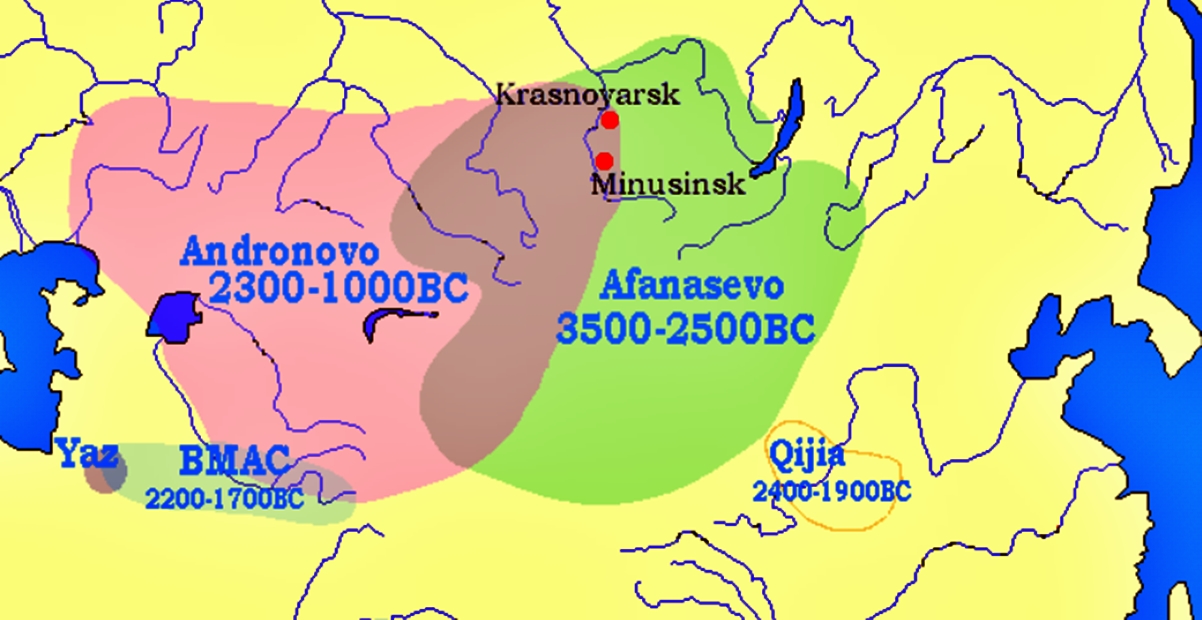
In the second half of the third millennium BC, bronze working reached the cultures of western Siberia. Chalcolithic groups in the eastern Ural foothills developed the so-called Andronovo culture, which took various local forms. The settlements of Arkaim, Olgino und Sintashta are particularly notable as the earliest evidence for urbanisation in Siberia. In the valleys of the Ob and Irtysh the same ceramic cultures attested there during the neolithic continue. The changes in the Baikal region and Yakutia were very slight.
In the middle Bronze Age, between 1800 and 1500 BC, the west Siberian Andronovo culture expanded markedly to the east and even reached the Yenissei valley. In all the local forms of the Andronovo cultue, homogenous ceramics are found, which also extended to the cultures on the Ob. Here, however, unique neolithic ceramic traditions were maintained as well.
With the beginning of the late Bronze Age, between 1500 and 800 BC, crucial cultural developments took place in southern Siberia. The Andronovo culture dissolved and its southern successors produced an entirely new form of pottery, with bulbous ornamental elements. At the same time the southern cultures also developed new forms of bronze working, probably as a result of influence from the southeast. These changes were especially significant in the Baikal region. There, the chalcolithic material culture which had continued up to this time was replaced by a bronze-working pastoralist culture. There and in Yakutia, bronze was only used as a material for the first time at this point.
The cultural continuity on the Ob continued in the first millennium B.C., as the Iron Age began in Siberia. The local ceramic style continues there even in this period. A much larger break occurred in the central Asian steppe: the sedentary, predominantly pastoralist society of the late Bronze Age is replaced by the mobile horse nomads which would continue to dominate this region until modern times.
The mobility, which the new cultural form enabled, unleashed a powerful dynamic, since henceforth the people of Central Asia were able to move across the steppe in great numbers. The neighbouring sedentary cultures were not unaffected by this development. Ancient China was threatened by the Xiongnu and their neighbours, the ancient states of modern Iran were opposed by the Massagetae and Sakas, and the Roman empire eventually was confronted by the Huns. The social changes are clearly indicated in the archaeological finds. Settlements are no longer found, members of the new elite were buried in richly furnished kurgans and completely new forms of art developed.
In the damper steppes to the north, the sedentary pastoralist culture of the late Bronze Age developed under the influence of the material culture of the nomads. Proto-urban settlements like Tshitsha form the late Irmen culture in west Siberia and the settlements in the north of the Xiongnu cultural area.In many places the transition to later periods remains problematic due to the lack of archaeological evidence.
Nevertheless, some generalisations are possible. In the Central Asian steppes, Turkic groups become detectable sometime in the 5th century. Over the following centuries, they expand to the north and west until eventually they brought the whole of southern Siberia under their control. The area further north, where the speakers of Uralic and Paleosiberian languages were located is still poorly known.
The next clear break in the history of Siberia is the Russian expansion into the east which began in the 16th century and only concluded in the 19th century. This process marks the beginning of modernity in Siberia.
The Cucuteni-Trypillian culture (known as Cucuteni in Romanian and Trypilska in Ukrainian), is a Neolithic–Eneolithic archaeological culture (circa 6000 to 3500 BC) in Eastern Europe. It extends from the Carpathian Mountains to the Dniester and Dnieper regions, centered on modern-day Moldova and covering substantial parts of western Ukraine and northeastern Romania, encompassing an area of 350,000km2.
The culture was initially named after the village of Cucuteni in Iași County, Romania. In 1884, Teodor Burada, after having seen ceramic fragments in the gravel used to maintain the road from Târgu Frumos to Iași, investigated the quarry in Cucuteni from where the material was mined, where he found fragments of pottery and terracotta figurines. Burada and other scholars from Iași, began the first excavations at Cucuteni in the spring of 1885. Their findings were published in 1885 and 1889, and presented in two international conferences in 1889, both in Paris.
At the same time, the first Ukrainian sites ascribed to the culture were discovered by Vincent Chvojka, Czech amateur archeologist. The year of his discoveries has been variously claimed as 1893, 1896 and 1887. Subsequently, Vincent Chvojka presented his findings at the 11th Congress of Archaeologists in 1897, which is considered the official date of the discovery of the Trypillian Culture in Ukraine. The Cucuteni-Trypillian culture is commonly divided into an Early, Middle, Late period, with varying smaller sub-divisions marked by changes in settlement and material culture. A key point of contention lies in how these phases correspond to radiocarbon data.
Throughout the 2,750 years of its existence, the Cucuteni-Trypillian culture was fairly stable and static; however, there were changes that took place. These include the basic economic conditions of the culture, the development of trade, interaction with other cultures, and the apparent use of barter tokens, an early form of money. Members of the Cucuteni-Trypillian culture shared common features with other Neolithic societies, including: An almost nonexistent social stratification; Lack of a political elite; Rudimentary economy, most likely a subsistence or gift economy; Pastoralists and subsistence farmers.
The Cucuteni-Trypillian culture was a society of subsistence farmers. Cultivating the soil (using an ard or scratch plough), harvesting crops and tending livestock was probably the main occupation for most people. Typically for a Neolithic culture, the vast majority of their diet consisted of cereal grains. They cultivated club wheat, oats, rye, proso millet, barley and hemp, which were probably ground and baked as unleavened bread in clay ovens or on heated stones in the home. They also grew peas and beans, apricot, cherry plum and wine grapes – though there is no solid evidence that they actually made wine. There is also evidence that they may have kept bees.
The zooarchaeology of Cucuteni-Trypillian sites indicate that the inhabitants practiced animal husbandry. Their domesticated livestock consisted primarily of cattle, but included smaller numbers of pigs, sheep and goats. There is evidence, based on some of the surviving artistic depictions of animals from Cucuteni-Trypillian sites, that the ox was employed as a draft animal. Hunting supplemented the Cucuteni-Trypillian diet. They used traps to catch their prey, as well as various weapons, including the bow and arrow, the spear, and clubs. To help them in stalking game, they sometimes disguised themselves with camouflage. Remains of game species found at Cucuteni-Trypillian sites include red deer, roe deer, aurochs, wild boar, fox and brown bear. The Cucuteni-Trypillian culture is known by its distinctive settlements, architecture, intricately decorated pottery and anthropomorphic and zoomorphic figurines, which are preserved in archaeological remains. At its peak it was one of the most technologically advanced societies in the world at the time, developing new techniques for ceramic production, housing building and agriculture, and producing woven textiles.
In terms of overall size, some of Cucuteni-Trypillian sites, such as Talianki (with a population of 15,000 and covering an area of 335 hectares) in the province of Uman Raion, Ukraine, are as large as (or perhaps even larger than) the more famous city-states of Sumer in the Fertile Crescent, and these Eastern European settlements predate the Sumerian cities by more than half of a millennium. These settlements underwent periodical acts of destruction and re-creation, as they were burned and then rebuilt every 60–80 years. Some scholars have theorized that the inhabitants of these settlements believed that every house symbolized an organic, almost living, entity.
Most Cucuteni-Trypillian pottery was hand coiled from local clay. Long coils of clay were placed in circles to form first the base and then the walls of the vessel. Once the desired shape and height of the finished product was built up the sides would then be smoothed to create a seamless surface. This technique was the earliest form of pottery shaping and the most common in the Neolithic; however, there is some evidence that they also used a primitive type of slow-turning potter's wheel, an innovation that did not become common in Europe until the Iron Age.
Characteristically vessels were elaborately decorated with swirling patterns and intricate designs. Sometimes decorative incisions were added prior to firing, and sometimes these were filled with colored dye to produce a dimensional effect. In the early period, the colors used to decorate pottery were limited to a rusty-red and white. Later, potters added additional colors to their products and experimented with more advanced ceramic techniques. The pigments used to decorate ceramics were based on iron oxide for red hues, calcium carbonate, iron magnetite and manganese Jacobsite ores for black, and calcium silicate for white. Very few researchers, believe that the Cucuteni culture used the wheel with wagons. However, only miniature models of animals on 4 wheels have been found, and they date to the first half of the fourth millennium BC. Such models are often thought to have been children's toys; nevertheless, the do convey the idea that objects could be pulled on wheels. Up to now there is no whatever evidence for wheels used with real wagons. Some Cucuteni-Trypillian communities have been found that contain a special building located in the center of the settlement, which archaeologists have identified as sacred sanctuaries. Artifacts have been found inside these sanctuaries, some of them having been intentionally buried in the ground within the structure, that are clearly of a religious nature, and have provided insights into some of the beliefs, and perhaps some of the rituals and structure, of the members of this society. Additionally, artifacts of an apparent religious nature have also been found within many domestic Cucuteni-Trypillian homes.
Many of these artifacts are clay figurines or statues. Archaeologists have identified many of these as fetishes or totems, which are believed to be imbued with powers that can help and protect the people who look after them. These Cucuteni-Trypillian figurines have become known popularly as goddesses; however, this term is not necessarily accurate for all female anthropomorphic clay figurines, as the archaeological evidence suggests that different figurines were used for different purposes (such as for protection), and so are not all representative of a goddess. There have been so many of these figurines discovered in Cucuteni-Trypillian sites that many museums in eastern Europe have a sizeable collection of them, and as a result, they have come to represent one of the more readily identifiable visual markers of this culture to many people.
There is a debate among scholars regarding how the end of the Cucuteni-Trypillian culture took place. According to some proponents of the Kurgan hypothesis of the origin of Proto-Indo-Europeans, and in particular the archaeologist Marija Gimbutas, the Cucuteni-Trypillian culture was destroyed by force. Arguing from archaeological and linguistic evidence, Gimbutas concluded that the people of the Kurgan culture (a term grouping the Yamna culture and its predecessors) of the Pontic–Caspian steppe, being most likely speakers of the Proto-Indo-European language, effectively destroyed the Cucuteni-Trypillian culture in a series of invasions undertaken during their expansion to the west. Based on this archaeological evidence Gimbutas saw distinct cultural differences between the patriarchal, warlike Kurgan culture and the more peaceful matriarchal Cucuteni-Trypillian culture, which she argued was a significant component of the "Old European cultures" which finally met extinction in a process visible in the progressing appearance of fortified settlements, hillforts, and the graves of warrior-chieftains, as well as in the religious transformation from the matriarchy to patriarchy, in a correlated east-west movement. Accordingly, these proponents of the Kurgan hypothesis hold that this invasion took place during the third wave of Kurgan expansion between 3000-2800 BC, permanently ending the Cucuteni-Trypillian culture.
In the 1990s and 2000s, another theory regarding the end of the Cucuteni-Trypillian culture emerged based on climatic change that took place at the end of their culture's existence that is known as the Blytt–Sernander Sub-Boreal phase. Beginning around 3200 BC, the earth's climate became colder and drier than it had ever been since the end of the last Ice age, resulting in the worst drought in the history of Europe since the beginning of agriculture. The Cucuteni-Trypillian culture relied primarily on farming, which would have collapsed under these climatic conditions in a scenario similar to the Dust Bowl of the American Midwest in the 1930s. According to that theory, the neighboring Yamna culture people were pastoralists, and were able to maintain their survival much more effectively in drought conditions. This has led some scholars to come to the conclusion that the Cucuteni-Trypillian culture ended not violently, but as a matter of survival, converting their economy from agriculture to pastoralism, and becoming integrated into the Yamna culture.