Showing posts with label Roman Empire. Show all posts

Wednesday, April 12, 2023

The Belgae Tribes and the Roman conquest of Belgium


The Belgae were a group of tribes living in northern Gaul, on the west bank of the Rhine, from at least the third century BC. They gave their name to the Roman province of Gallia Belgica, and very much later, to the modern country of Belgium.

From 500 BC Celtic tribes settled in the region of present day Belgium, and traded with the Mediterranean world. The Roman influence penetrated into those areas about 150 BC., when the first coins came into use.

Julius Caesar
Julius Caesar describes Gaul at the time of his conquests (58–51 BC) as divided into three parts, inhabited by the Aquitani in the southwest, the Gauls of the biggest central part, and the Belgae in the north. Each of these three parts was different in terms of customs, laws, and language.

He noted that the Belgae, were "the bravest, because they are furthest from the civilization and refinement of [our] Province, and merchants least frequently resort to them, and import those things which tend to effeminate the mind; and they are the nearest to the Germans, who dwell beyond the Rhine , with whom they are continually waging war".
Gallia map

For a long time the Belgae were considered to be Gallic people, or a Germanic people dominated by a Gallic aristocracy (hypothesis suggested by the fact that the names of the Belgae chiefs are of Celtic origin, as well as ancient and non-Germanic toponyms).
Belgae house

More precise analyzes of the names of the tribes, their chiefs and their gods lead to these various assumptions: some tribes would be genuinely Gallic (such as the Remi, the Bellovaci, the Morini or the Atrebates), others would show Germanic features (Nervii, Aduatuci, Condrusi, Menapii, Treveri ...) according to Caesar.

Caesar reported that the more northerly allies of the Belgae, from west to east the Menapii, Nervii, and Germani cisrhenani, were less economically developed and more warlike, similar to the Germani east of the Rhine river. The Menapii and northern Germani lived among low thorny forests, islands and swamps, and the central Belgian Nervii lands were deliberately planted with thick hedges, in order to be impenetrable to cavalry.
Belgae in England

During the late 2nd or early 1st century bc, a small group of Belgae crossed to Britain. After further Gallic victories by Caesar, other settlers took refuge across the Channel, and Belgic culture spread to most of lowland Britain. The three most important Belgic kingdoms, identified by their coinage, were centred at Colchester, St. Albans, and Silchester. The chief Belgic contribution to southern Britain was the introduction of the heavy plow, which was used to clear many lands previously untillable.

Caesar writes that the Belgae were conspiring and arming themselves in response to his earlier conquests; to counter this threat, he raised two new legions and ordered his Gallic allies, the Aedui, to invade the territory of the Bellovaci, the largest and fiercest of the Belgae tribes, in 57 BC.

Cautious of the numbers and bravery of the Belgae, Caesar initially avoided a pitched battle, resorting mainly to cavalry skirmishes to probe their strengths and weaknesses. Once he was satisfied his troops were a match for them, he made camp on a low hill protected by a marsh at the front and the river Aisne behind, near Bibrax (between modern Laon and Reims) in the territory of the Remi.
Belgae attack

The Belgae attacked over the river, but were repulsed after a fierce battle. Realising they could not dislodge the Romans and aware of the approach of the Aedui into the lands of the Bellovaci, the Belgae decided to disband their combined force and return to their own lands. Caesar's informants advised him that whichever tribe he would attacked first, the others would come to their defence. At daybreak, Caesar sent his cavalry to harass the rear guard of the Belgae, killing many of them.
Caesar next marched into the territory of the Suessiones and besieged the town of Noviodunum (Soissons). Seeing the Romans' siege engines, the Suessiones surrendered, whereupon Caesar turned his attention to the Bellovaci, who had retreated into the fortress of Bratuspantium (between modern Amiens and Beauvais). They quickly surrendered, as did the Ambiani.
roman camp on hill

The Nervii, along with the Atrebates and Viromandui, decided to fight. They concealed themselves in
angry Caesar attack
the forests and attacked the approaching Roman column at the river Sabis.  Their quick and unexpected attack left the Romans exposed. However, Caesar grabbed a shield, made his way to the front line, and quickly organised his forces. The two Roman legions guarding the baggage train at the rear finally arrived and helped to turn the tide of the battle. Caesar says the Nervii were almost annihilated in the battle, and is effusive in his tribute to their bravery, calling them "heroes".

The Atuatuci, who were marching to their aid, turned back on hearing of the defeat and retreated to one stronghold, were put under siege, and soon surrendered and handed over their arms. However, the surrender was a ploy, and the Atuatuci, armed with weapons they had hidden, tried to break out during the night. The Romans had the advantage of position and killed 4000. The rest, about 53 thousand, were sold into slavery.
Ambiorix

In 53 BC, the Eburones, led by Ambiorix, along with the Nervii, Menapii, and Morini, revolted again and wiped out 15 cohorts, only to be put down by Caesar. The following year, Belgae fought again, in the uprising of Vercingetorix.
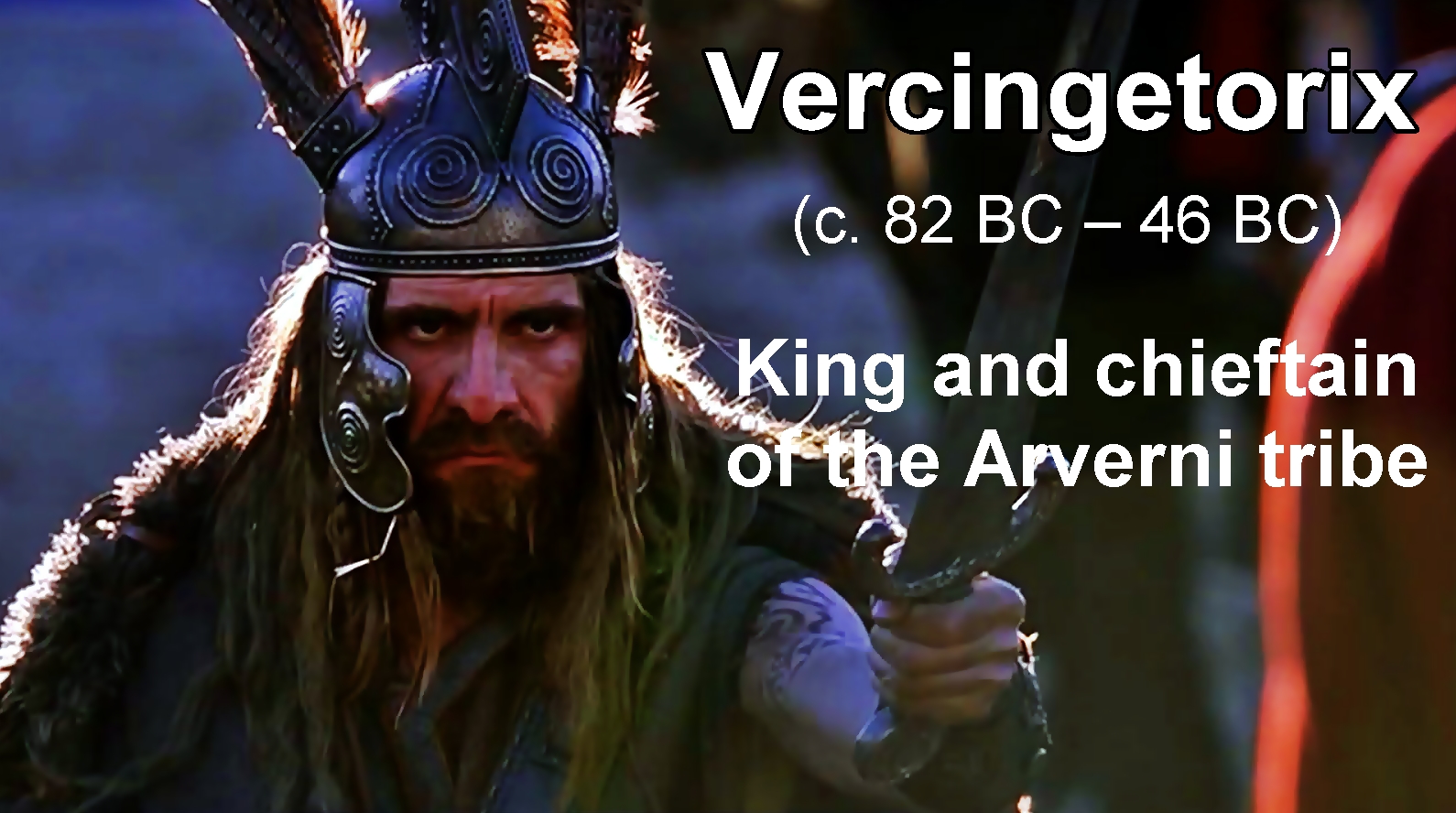
Vercingetorix

After their final subjugation, Caesar combined the three parts of Gaul, the territory of the Belgae, Celtae, and Aquitani, into a single unwieldy province (Gallia Comata, "long-haired Gaul").

Monday, April 10, 2023

Roman conquest of Britain (43 – 84 AD)


The Roman conquest of Britain was a gradual process, beginning effectively in A.D. 43 under Emperor Claudius, whose general Aulus Plautius served as first governor of Roman Britain.
Britain had enjoyed diplomatic and trading links with the Romans

Julius Caesar
since Julius Caesar's expeditions in 55 and 54 B.C., and Roman economic and cultural influence was a significant part of the British late pre-Roman Iron Age, especially in the south.
Augustus

Augustus prepared invasions in 34 B.C., 27 B.C. and 25 B.C. The first and third were called off due to revolts elsewhere in the empire, the second because the Britons seemed ready to come to terms. According to Strabo's Geography, written during this period, says Britain paid more in customs and duties than could be raised by taxation if the island were conquered.

Commius

By the 40s A.D., the political situation within Britain was apparently in ferment. The Catuvellauni had displaced the Trinovantes as the most powerful kingdom in south-eastern Britain, taking over the former Trinovantian capital of Camulodunum, and were pressing their neighbours the Atrebates, ruled by the descendants of Julius Caesar's former ally Commius.

Claudius

In 43 Claudius mounted an invasion force to re-instate Verica, an exiled king of the Atrebates. Aulus Plautius, a distinguished senator, was given overall charge of four legions, totalling about 20,000 men, plus about the same number of auxiliaries.

Verica

The main invasion force under Aulus Plautius crossed in three divisions. The port of departure is usually taken to have been Boulogne, and the main landing at Richborough. Neither of these locations is certain.

Aulus Plautius

British resistance was led by Togodumnus and Caratacus, sons of the late king of the Catuvellauni, Cunobeline. A substantial British

Caratacus
force met the Romans at a river crossing thought to be near Rochester on the River Medway. The battle raged for two days. Hosidius Geta was almost captured, but recovered and turned the battle so decisively that he was awarded the "Roman triumph".
The British were pushed back to the Thames. They were pursued by the Romans across the river causing some Roman losses in the marshes of Essex. Whether the Romans made use of an existing bridge for this purpose or built a temporary one is uncertain.

Togodumnus

Togodumnus died shortly after the battle on the Thames. Plautius halted and sent word for Claudius to join him for the final push. Cassius Dio presents this as Plautius needing the emperor's

Cassius Dio
assistance to defeat the resurgent British, who were determined to avenge Togodumnus. However, Claudius was no military man. Claudius's arch says he received the surrender of eleven kings without any loss. Cassius Dio relates that he brought war elephants and heavy armaments which would have overawed any remaining native resistance. The Romans established their new capital at Camulodunum and Claudius returned to Rome to celebrate his victory. Caratacus escaped and would continue the resistance further west.
Vespasian

Vespasian took a force westwards subduing tribes and capturing oppida as he went, going at least as far as Exeter.  In the north, within four years of the invasion it is likely that an area south of a line from the Humber to the Severn Estuary was under Roman control.

Publius Ostorius Scapula

Late in 47 the new governor of Britain, Publius Ostorius Scapula, began a campaign against the tribes of modern-day Wales, and the Cheshire Gap. The Silures of southeast Wales caused considerable problems to Ostorius and fiercely defended the Welsh border country. Caratacus himself was defeated in the Battle of Caer Caradoc and fled to the Roman client tribe of the Brigantes who occupied the Pennines.

Nero

When Nero became emperor in 54, he seems to have decided to continue the invasion. Gaius Suetonius Paulinus mounted a successful campaign across Wales, famously destroying the druidical centre at Mona or Anglesey in 60 at what historians later

Gaius Suetonius Paulinus
called the Menai Massacre. Final occupation of Wales was postponed however when the rebellion of Boudica forced the Romans to return to the south east. The Silures were not finally
Sextus Julius Frontinus
conquered until circa 76 when Sextus Julius Frontinus' long campaign against them began to have success.

Following the successful suppression of Boudica's uprising, a number of new Roman governors continued the conquest by edging north.

Boudica

Arriving in mid-summer of 78, Agricola found several previously defeated peoples had re-established their independence. The first to be dealt with were the Ordovices of north Wales, who had destroyed a cavalry ala of Roman auxiliaries stationed in their territory. Knowing the terrain from his prior military service in

Agricola
Britain, he was able to move quickly to defeat and virtually exterminate them. He then invaded Anglesey, forcing the inhabitants to sue for peace. The following year he moved against the Brigantes of northern England and the Selgovae along the southern coast of Scotland, using overwhelming military power to re-establish Roman control.
Tacitus

Tacitus says that after a combination of force and diplomacy quieted discontent among the Britons who had been conquered previously, Agricola built forts in their territories in 79. In 80 he marched to the Firth of Tay, not returning south until 81, at which time he consolidated his gains in the new lands that he had conquered, and in the rebellious lands that he had re-conquered. In 82 he sailed to either Kintyre or the shores of Argyll, or to both. In

Calgacus
83 and 84 he moved north along Scotland's eastern and northern coasts using both land and naval forces, campaigning successfully against the inhabitants, and winning a significant victory over the northern British peoples led by Calgacus at the Battle of Mons Graupius.

Prior to his recall in 84, Agricola built a network of military roads and forts to secure the Roman occupation. Existing forts were strengthened and new ones planted in northeastern Scotland along
Roman maximum conquests in Britain
the Highland Line, consolidating control of the glens that provided access to and from the Scottish Highlands. In southern-most Caledonia, the lands of the Selgovae, approximating to modern Dumfriesshire and the Stewartry of Kirkcudbright, were heavily planted with forts, not only establishing effective control there, but also completing a military enclosure of south-central Scotland. In contrast to Roman actions against the Selgovae, the territories of the Novantae, Damnonii, and Votadini were not planted with forts, and there is nothing to indicate that the Romans were at war with them.

Domitian


Agricola was recalled to Rome by Domitian. His successors are not named in any surviving source, but it seems they were unable or unwilling to further subdue the far north. Fortifications of the Gask Ridge in Perthshire, erected to consolidate the Roman presence in Scotland in the aftermath of Mons Graupius, were abandoned within the space of a few years. It is equally likely that the costs of a drawn-out war outweighed any economic or political benefit and it was more profitable to leave the Caledonians alone and only under de jure submission.

Hadrian Wall and Antonine Wall map

Roman occupation was withdrawn to a line subsequently established by the construction of Hadrian's Wall. An attempt was made to push this line north to the River Clyde-River Forth area in 142 when the Antonine Wall was constructed. This was once again abandoned after two decades and only subsequently re-occupied on an occasional basis.

Saturday, April 8, 2023

Kingdom of Pontus during the reign of Mithridates VI


Mithridates VI, also known as Mithradates the Great and Eupator Dionysius, was king of Pontus and Armenia Minor in northern Anatolia, now Turkey, from about 120 to 63 BC. 
Mithridates VI

Mithridates is remembered as one of the Roman Republic’s most formidable and successful enemies, who engaged three of the prominent generals from the late Roman Republic in the Mithridatic Wars: Lucius Cornelius Sulla, Lucius Licinius Lucullus and Gnaeus Pompeius Magnus. He is often considered the greatest ruler of the Kingdom of Pontus.
Lucius Cornelius Sulla


Mithridates was born in the Pontic city of Sinope, and was raised in the Kingdom of Pontus. He was the first son among the children born to Laodice VI and Mithridates V of Pontus. Mithridates V was assassinated in about 120 BC in Sinope, poisoned by unknown 


Mithridates V of Pontus

persons at a lavish banquet which he held. He left the kingdom to the joint rule of Mithridates' mother, Laodice VI, Mithridates, and his younger brother, Mithridates Chrestus. Neither Mithridates nor his younger brother were of age, and their mother retained all power as regent for the time being.  Laodice VI’s regency over Pontus was from 120 BC to 116 BC or 113 BC, and favored Mithridates Chrestus over Mithridates. During his mother’s regency, he escaped from his mother's plots against him, and went into hiding.
Laodice VI


Mithridates emerged from hiding, returning to Pontus between 116 BC and 113 BC and was hailed as king. He removed his mother and brother from the throne, imprisoning both, becoming the sole

Mithridates Chrestus
ruler of Pontus. Laodice VI and Mithridates Chrestus died in prison, and Mithridates gave both royal funerals. Mithridates first married his younger sister Laodice, aged 16. His goal was to preserve the purity of their bloodline, solidify his claim to the throne, to co-rule over Pontus, and to ensure the succession to his legitimate children.
Laodice QUEEN SISTER

Mithridates entertained ambitions of making his state the dominant power in the Black Sea and Anatolia. He first subjugated Colchis, a region east of the Black Sea, and prior to 164 BC, an independent kingdom. He then clashed for supremacy on the Pontic steppe with the Scythian King Palacus. The most important centres of Crimea, Tauric Chersonesus and the Bosporan Kingdom readily surrendered their independence in return for Mithridates' promises to protect them against the Scythians, their ancient enemies. After several abortive attempts to invade the Crimea, the Scythians and the allied Rhoxolanoi suffered heavy losses at the hands of the Pontic general Diophantus and accepted Mithridates as their overlord.

The young king then turned his attention to Anatolia, where Roman

Nicomedes III of Bithynia
power was on the rise. He contrived to partition Paphlagonia and Galatia with King Nicomedes III of Bithynia. It soon became clear to Mithridates that Nicomedes was steering his country into an anti-Pontic alliance with the expanding Roman Republic. When Mithridates fell out with Nicomedes over control of Cappadocia, and defeated him in a series of battles, the latter was constrained to openly enlist the assistance of Rome. The Romans twice interfered in the conflict on behalf of Nicomedes, leaving Mithridates, should he wish to continue the expansion of his kingdom, with little choice other than to engage in a future Roman-Pontic war.
Nicomedes IV of Bithynia

The next ruler of Bithynia, Nicomedes IV of Bithynia, was a figurehead manipulated by the Romans. Mithridates plotted to overthrow him, but his attempts failed and Nicomedes IV, instigated by his Roman advisors, declared war on Pontus. Rome itself was involved in the Social War, a civil war with its Italian allies. Thus, in all of Roman Asia Province there were only two legions present in Macedonia. These legions combined with Nicomedes IV's army to invade Mithridates' kingdom of Pontus in 89 BC. Mithridates, however, won a decisive victory, scattering the Roman-led forces. His victorious forces were welcomed throughout Anatolia. The following year, 88 BC, Mithridates orchestrated a massacre of Roman and Italian settlers remaining in several Anatolian cities, essentially wiping out the Roman presence in the region. This episode is known as the Asiatic Vespers.

Asiatic Vespers


The Greek cities, including Athens, defected to the side of Mithridates and welcomed his armies in mainland Greece, while his fleet besieged the Romans at Rhodes. Neighboring King of Armenia Tigranes the Great established an alliance with Mithridates and married one of Mithridates’ daughters, Cleopatra of Pontus. They would support each other in the coming conflict with Rome.

Tigranes the Great


The Romans responded by organising a large invasion force to defeat him and remove him from power. The First Mithridatic War, fought between 88 BC and 84 BC, saw Lucius Cornelius Sulla force Mithridates VI out of Greece proper. After victory in several

The First Mithridatic War
battles, Sulla received news of trouble back in Rome posed by his enemy Gaius Marius and hurriedly concluded peace talks with Mithridates. As Sulla returned to Italy Lucius Licinius Murena was
Gaius Marius
left in charge of Roman forces in Anatolia. The lenient peace treaty, which was never ratified by the Senate, allowed Mithridates VI to
Lucius Licinius Murena
recoup his forces. Murena attacked Mithridates in 83 BC, provoking the Second Mithridatic War from 83 BC to 81 BC. Mithridates scored a victory over Murena's green forces before peace was again declared by treaty.

Lucius Licinius Murena


When Rome attempted to annex Bithynia, Mithridates VI attacked with an even larger army, leading to the Third Mithridatic War from

Third Mithridatic War
73 BC to 63 BC. First Lucullus and then Pompey were sent against
Lucius Licinius Lucullus
Mithridates VI, who surged back to retake his kingdom of Pontus, but was at last defeated by Pompey. After Pompey defeated him in Pontus in 66 BC, Mithridates VI fled with a small army to Colchis
Gnaeus Pompeius Magnus
in modern Georgia, and then over the Caucasus Mountains to Crimea and made plans to raise yet another army to take on the Romans. His eldest living son, Machares, viceroy of Cimmerian Bosporus, was unwilling to aid his father. Mithridates had
Machares
Machares killed, and Mithridates took the throne of the Bosporan Kingdom. Mithridates then ordered the conscriptions and preparations for war. In 63 BC, Pharnaces II of Pontus, one of his sons, led a rebellion against his father, joined by Roman exiles in the core of Mithridates' Pontic army. Mithridates withdrew to the citadel in Panticapaeum, where he committed suicide. Pompey buried Mithridates in the rock-cut tombs of his ancestors in Amasya, the old capital of Pontus.

Pharnaces II of Pontus

After his death. Most of the western half of Pontus and the Greek cities of the coast, including Sinope, were annexed by Rome directly as part of the Roman province of Bithynia et Pontus. The interior and eastern coast remained an independent client kingdom.

Thursday, April 6, 2023

Sack of Rome by Alaric in 410


The Sack of Rome which occurred on August 24, 410, was done by the Visigoths led by King Alaric. At that time, Rome was no longer the capital of the Western Roman Empire, having been replaced in that position first by Mediolanum in 286 and then by Ravenna in 402. 
Western and Eastern Roman Empires in 395

For centuries the people of Rome lived comfortably behind the walls of their city. The empire was continually expanding, and the army, under a long series of capable military commanders, kept the dreaded barbarians safely away from the city’s gates. Unfortunately, the supremacy of Rome began to slowly decay when the empire was split into two by Diocletian, and the power base gradually moved to Constantinople.

Goths invasion of 376

The Goths, one of the Germanic tribes, had invaded the Roman Empire on and off since 238. In 376, the Huns forced many Therving Goths to seek refuge in the Eastern Roman Empire. Soon after, starvation, high taxes, hatred from the Roman population, and governmental corruption turned the Goths against the Empire.  The Goths rebelled and began looting and pillaging throughout the eastern Balkans. A Roman army, led by the Eastern Roman Emperor Valens, marched

Eastern Roman Emperor Valens
to put them down. At the Battle of Adrianople in 378, Fritigern decisively defeated emperor Valens, who was killed in battle.  Peace was eventually established in 382 when the new Eastern Emperor, Theodosius I,
Fritigern
signed a treaty with the Thervings, who would become known as the Visigoths. The treaty made the Visigoths subjects of the empire as foederati. They were allotted the northern part of the dioceses of Dacia and Thrace, and while the land remained under Roman sovereignty and the Visigoths were expected to provide military service, they were considered autonomous.
Alaric

In 391, a Gothic chieftain named Alaric was declared king by a group of Visigoths, though the exact time this happened and nature of this position are debated. Although labelled as a barbarian, Alaric was a Christian who received his military training in the Roman army. He commanded the Gothic allies, fighting alongside the Romans at the battle of River Frigidus in 394, a battle waged

Theodosius I
between the eastern emperor Theodosius I and the western usurper emperor Eugenius. Shortly after the battle, in 395, Emperor Theodosius, the last to unite and rule both halves of the empire, died. The empire was again divided. Alaric’s nemesis, and later ally, the ambitious Flavius Stilicho became regent, or at least claimed to be, for the former emperor’s two sons, Arcadius and Honorius. Arcadius became emperor in the east, while the younger Honorius would eventually assume the throne in the west.
Flavius Stilicho

When Theodosius died on January 17, 395, the Visigoths considered their 382 treaty with Rome at an end. Alaric quickly led his warriors back to their lands in Moesia, gathered most of the federated Goths in the Danubian provinces under his leadership, and instantly

circle of wagons
rebelled, invading Thrace and approaching the Eastern Roman capital of Constantinople.  Magister utriusque militia Stilicho marched east at the head of a combined Western and Eastern Roman army out of Italy. Alaric fortified himself behind a circle of wagons on the plain of Larissa, in Thessaly, where Stilicho besieged him for several months, unwilling to seek battle. Eventually Arcadius, under the apparent influence of those hostile to Stilicho, commanded him to leave Thessaly. Stilicho obeyed the orders of his emperor, sending his Eastern troops to Constantinople, and leading his Western ones back to Italy. The withdrawal of Stilicho freed
emperor Honorius
Alaric to pillage much of Greece, including Piraeus, Corinth, Argos, and Sparta. Athens was able to pay a ransom to avoid being sacked.  Eastern Roman government offer terms to Alaric in 398. They made Alaric magister militum per Illyricum, giving him the Roman command he wanted and giving him free rein to take what resources he needed, including armaments, in his assigned province.
Aurelianus, the new praetorian prefect of the east, stripped Alaric of his title to Illyricum in 400. Between 700 and 7000 Gothic soldiers and their families were slaughtered in a riot at Constantinople on
emperor Arcadius
July 12, 400. While Stilicho was busy fighting an invasion of Vandals and Alans in Rhaetia and Noricum, Alaric led his people into an invasion of Italy in 401, reaching it in November without encountering much resistance. The Goths captured a few unnamed cities and besieged the Western Roman capital Mediolanum. Honorius, fearful after the near capture of Mediolanum, moved the Western Roman capital to Ravenna, which was more defensible with its natural swamps and more escapable with its access to the sea.

Illyricum map

In time, Alaric became an ally of Stilicho, agreeing to help claim the praetorian prefecture of Illyricum for the Western Empire. To that end, Stilicho named Alaric magister militum of Illyricum in 405. The Roman commander listened to Alaric’s demand of legal rights to their land with annual payments of gold and grain. In return, Alaric was to assist Stilicho in his plan to invade the east. With Arcadius in full power in the east, Stilicho had already secured himself in the west. He had married his daughter to Emperor Honorius, and with the help of Alaric, he would attack the east, dethroning Arcadius.

Theodosius II

Eastern Roman Emperor Arcadius died on May 1, 408 of illness. He was succeeded by his young son, Theodosius II. Honorius wanted to go East to secure his nephew’s succession, but Stilicho convinced him to stay and allow Stilicho himself to go instead. Olympius, a palatine official and an enemy of Stilicho’s spread false rumors that Stilicho planned to place his own son Eucherius on the throne of the East, and many came to believe them. Stilicho warned against the emperor leading the army, choosing to lead an army himself. With Stilicho away, Honorius and Olympius traveled to Ticinum, an Italian city just south of Milan, supposedly to review the troops.

visigoths campaigns
However, Olympius, without the permission of the emperor, ordered the killing of thousands of Gothic allies - an action that further angered Alaric. A final fatality of this massacre was Stilicho himself, who was accused of plotting with Alaric. As a result of this treachery, over 10,000 soldiers defected and joined Alaric’s army. In 408 the Gothic army sacked the cities of Aquilea, Concordia, Altinum, Cremona, Bononia, Ariminum, and Picenum, choosing, however, to avoid Ravenna, the capital of the western empire and home of Emperor Honorius. Instead, Alaric set his sights on Rome.
Siege of Rome

The Goths under Alaric laid siege to the city in late 408. Hopes of help from the Imperial government faded as the siege continued and Alaric took control of the Tiber river, which cut the supplies going into Rome. Grain was rationed to one-half and then one-third of its previous amount. Starvation and disease rapidly spread throughout the city, and rotting bodies were left unburied in the streets.  The

Tiber River Map
Roman Senate then decided to send two envoys to Alaric. Alaric demanded all the gold and silver, household goods, and barbarian slaves in the city. Ultimately, the city was forced to give the Goths 5000 pounds of gold, 30000 pounds of silver, 4000 silken tunics, 3000 hides dyed scarlet, and 3000 pounds of pepper in exchange for lifting the siege. The barbarian slaves fled to Alaric as well, who swelled his ranks to about 40000. Honorius consented to the payment of the ransom, and with it the Visigoths lifted the siege and withdrew to Etruria in December 408.
Athaulf
 
Honorius remained blind to the seriousness of the situation. While temporarily agreeing to Alaric’s demands - something he never intended to honor – 6000 Roman soldiers were sent to the city but were quickly defeated by Alaric’s brother-in-law Athaulf. Alaric wanted yearly tribute in gold and grain, and lands in the provinces of Dalmatia, Noricum, and Venetia for his people. Honorius sent an insulting letter to Alaric, which was read out in the negotiations.

Priscus Attalus
Realizing further negotiations were impossible, Alaric returned to the gates of Rome in late 409. Faced with the return of starvation and disease, the Senate met with Alaric. He demanded that they appoint one of their own as Emperor to rival Honorius, and he instigated the election of the elderly Priscus Attalus to that end, a pagan who permitted himself to be baptized. Alaric was then made magister utriusque militiae and his brother-in-law Ataulf was given the position comes domesticorum equitum in the new, rival government, and the siege was lifted. 
Sarus

Honorius arranged for a meeting with Alaric about 12 kilometers outside of Ravenna. As Alaric waited at the meeting place, Sarus, who was a sworn enemy of Ataulf and now allied to Honorius, attacked Alaric and his men with a small Roman force. Alaric survived the attack and, outraged at this treachery and frustrated by all the past failures at accommodation, gave up on negotiating with Honorius and headed back to Rome, which he besieged for the third and final time.

Salarian Gate
On August 24, 410, the Visigoths entered Rome through its Salarian Gate, according to some opened by treachery, according to others by want of food, and pillaged the city for three days.
Sack of Rome

Because the barbarians had converted to Christian sect Arianism, it was not a particularly violent looting with relatively little rape, murder and damage to buildings.  Some famous monuments and buildings were left untouched, and since the Goths were Christians, they allowed people to take refuge inside the basilicas of St. Peter and St. Paul. Many of the city's great buildings were ransacked,

Gardens of Sallust
including the mausoleums of Augustus and Hadrian, in which many Roman Emperors of the past were buried. Structural damage to buildings was largely limited to the areas near the old Senate house and the Salarian Gate, where the Gardens of Sallust were burned and never rebuilt.  The Basilica Aemilia and the Basilica Julia were also burned.
Galla Placidia

After three days of looting and pillage, Alaric quickly left Rome and headed for southern Italy. He took with him the wealth of the city and a valuable hostage, Galla Placidia, the sister of emperor Honorius. The Visigoths ravaged Campania, Lucania, and Calabria. Nola and perhaps Capua were sacked, and the Visigoths threatened to invade Sicily and Africa.  However, they were unable to cross the Strait of Messina as the ships they had gathered were wrecked by a

Burial of Alaric
storm.  Alaric died of illness at Consentia in late 410, mere months after the sack.  According to legend, he was buried with his treasure by slaves in the bed of the Busento river. The slaves were then killed to hide its location. The Visigoths elected Ataulf, Alaric's brother-in-law, as their new king. The Visigoths then moved north, heading for Gaul. Ataulf married Galla Placidia in 414, but he died one year later. The Visigoths established the Visigothic kingdom in southwestern Gaul in 418.
Visigothic kingdom

This was the first time Rome had been sacked in 800 years, after this was done by Gallic tribes led by Brennus in 390 BC. It was shocking to people across both halves of the Empire who viewed Rome as the eternal city and the symbolic heart of their empire. Tens of thousands of Romans fled the economically ruined city into the countryside, with many of them seeking refuge in Africa. The city of Rome's total population fell from 800,000 in 408 to 500,000 by 419. A more severe sack of Rome by the Vandals followed in 455, and the Western Roman Empire finally collapsed in 476 when the Germanic Odovacer removed the last Western Roman Emperor, Romulus Augustulus, and declared himself King of Italy.

Roman Empire in 476 map