Showing posts with label Ottoman Empire. Show all posts
Tuesday, April 11, 2023
Principality of Theodoro (Mangup) - the last Byzantine state
The Principality of Theodoro also known as Gothia, or the Principality of Mangup, was a small, Christian feudal state in the southwestern part of Crimea, which existed from the 13th century to the 15th century. Its capital was Doros, also sometimes called Theodoro and now known as Mangup.
Gothia's population was a mixture of Greeks, Crimean Goths, Alans, Bulgars, Cumans, Kipchaks and other ethnic groups, most of whom were adherents to Orthodox Christianity and Hellenized. The principality's official language was Greek.
The principality was a successor state of the Byzantine Empire, and was formed at the beginning of the 13th century from that part of the former Byzantine theme of Kherson in the Crimea, which had not become a colony of Genoa.
In 1204, during the fourth crusade, the Venetians seized the best Byzantine ports: Cembalo, Soldaia and Caffa. The remainder of the theme falls to the Greek Empire of Trebizond (located on the other side of the Black Sea, and ruled by the Komnenos, then, in 1235, to the Greek Empire of Nicaea (governed by the Paleologues).
This dependence was never very strong and was eventually replaced by the invading Mongols, who in 1238 poured into the peninsula, occupied its east and enforced a tribute on the western half, including Gothia. Apart of said tribute their influence was limited, leaving administrative matters in native hands.
Mongol Khagan Möngke grants Caffa, Chimmero and Vosporo to the Genoese. Then, the Genoese obtained two other ports, Lusta and Caulita, in 1315 from the Greek Empire of Nicaea, in exchange for loans.
During this period, besides the Greeks of the Black Sea, Cherkessogais Armenians populate the region, as evidenced by the presence of many churches and Armenian monasteries such as that of the Holy Cross of Sourkhat.
In 1362, Demetrios Palaeologus-Gabras, founded The Armenian-Byzantine ruling dynasty of the Gabras, which was related by marriage with the Komnenos and the Paleologues. They bore the title of "Prince of Theodoro and Gothia". This dynasty makes of Theodoros an independent principality, which resists the Tatars and disputes with the Genoese the control of the coast.
In 1395 the warlord Tamerlane invaded the Crimean peninsula, destroying several towns including Gothia's capital Theodoro. After his death in 1404 the Principality of Theodoro grew to become one of the most significant powers of the Black Sea, profiting from a period of Genoese instability and its neglect of its Black Sea colonies, but also the rise of the Crimean Khanate. In 1432 the Principality of Theodoro sided with Venice against Genoa due to the latter's promise to grant them access to the sea.
The principality had peaceful relations with the Golden Horde to its north, paying an annual tribute as vassals, but was in constant strife with Genoese Gazaria colonies to the south over access to the coasts and the trade that went through the Crimean harbours. A narrow strip of the coastal land from Balaklava in the west to Alushta in the east initially part of the principality soon fell under Genoese control. After they had lost harbours on the southern coast Theodorites built a new port called Avlita at the mouth of the Chernaya River and fortified it with the fortress of Kalamita.
After the conquest of Constantinople in 1453 by the Ottomans, the capture of the despotate of Morea in 1460 and the Empire of Trebizond in 1461, Theodoro was the last Byzantine country to retain its political independence.
In the face of the mounting Ottoman danger, Isaac Paleologue-Gavras engaged in a reconciliation with the Genoese, and arrange a marriage between his sister Marie, and Stephen the Great, ruler of Moldavia in 1472. However, Isaac still isolated between Sultan Mehmed II and the Khan of Crimea, chose, in order to safeguard the autonomy of his principality, to recognize himself vassal of the Ottoman Empire.
Fearing this change of alliance, Stephen the Great has the idea to provide Alexander, a brother of Isaac, a small fleet and a contingent of 300 Moldovan soldiers to join Theodoro, where they dethrone and kill Isaac.
The reign of the new sovereign of Theodoros, installed by the Moldavians, is very short, because the Ottomans, allied with the Tatars and commanded by Pasha and Vizier Gedik Ahmed invaded Crimea in May 1475. In December 1475, after conquering the other Christian strongholds along the Crimean coast, the Ottomans captured the city of Theodoro after a three-month siege.
Alexander and his family were taken captive to Constantinople, where the prince was beheaded. His son was forcibly converted to Islam, and his wife and daughters became part of the Sultan's harem.
Principality of Theodoros became an Ottoman province, while the northern peninsula remain part of the Crimean khanate, vassal of the Sublime Porte. The principality of Theodoros is the last Byzantine state to disappear, 22 years after the fall of Constantinople.
Ada Kaleh island - the last Ottoman territory in Central Europe
Ada Kaleh was a small island on the Danube, between Romania and Serbia, that was submerged during the construction of the Iron Gates hydroelectric plant in 1970.
Ada-Kaleh Island was located 3 km downstream from the city of Orşova, it had an altitude of 48 meters, being dominated by the Alion hill, 317 meters high located north of the Danube and at south by Golubinska Planina. The length of the island was 1750 meters, and the width 400-500 meters.
The first documentary attestation of the island is a report of the Teutonic Knights of February 22, 1430, about the Banat fortifications, which talks about the island of Saan with 216 people.
Throughout history, it has carried many other names, including Caroline Island, Uj-Orsova Sziget (in Hungarian), Orsovostrvo (in Serbian) and Insula Orșovei (in Romanian). Its most widely used name is Ada Kaleh, literally meaning "Island Fortress" in Turkish.
The island of Ada Kaleh was of particular importance in the conflicts of the Habsburg Empire with the Ottoman Empire because of its strategic position. In 1689 the Austrian army built a fortress here. In the following decades, the island of Ada Kaleh was occupied successively on several occasions by Austria and the Ottoman Empire. Following the Peace Treaty of Belgrade of 1739, the island returned to the Ottoman Empire, with brief temporary interruptions in favor of the Austrians between 1789 and 1791.
After the Treaty of Sistova (1791), which ended the last war between the Ottoman Empire and the Habsburg Monarchy, the island lost its military importance. Ada-Kaleh remained under the Turkish control, while Austrians will take the nearby town of Orsova.
In 1804, during the First Serbian Uprising, Serbian rebels, led by Milenko Stojković, caught and executed the renegade Janissary officers who took power in the Sanjak of Smederevo, that had fled Belgrade and taken refuge on the island, thereby ending Dahije tyranny.
Even though the Ottomans lost the areas surrounding the island after the Russo-Turkish War (1877–1878), the island was totally forgotten during the peace talks at the Congress of Berlin in 1878, which allowed it to remain a de jure Ottoman territory. The areas surrounding the island were controlled by Austria-Hungary to the north and Serbia to the south, but the island was under Ottoman sovereignty.
The Ottoman Government continued to appoint a Mudir (mayor) and a Kadir (judge) regularly. The island's inhabitants (officially citizens of the Ottoman Empire) enjoyed exemption from taxes and customs and were not subject to conscription. The islanders also had the right to vote during the Ottoman general elections of 1908.
A mosque was built on the site of an earlier Franciscan monastery in 1903. The carpet of the mosque, was a gift from the Turkish Sultan Abdülhamid II.
On May 12, 1913, taking advantage of the Balkan Wars, the island was occupied by the forces of Austria-Hungary. This was one of the last unilateral territorial expansions of Austria-Hungary before the outbreak of the First World War; the seizure was never officially recognized by the Ottoman government.
On July 24, 1923, the new Republic of Turkey officially ceded Ada Kaleh to Romania with Articles 25 and 26 of the Treaty of Lausanne.
The population on the island lived primarily on the cultivation of tobacco, fishery and smuggling, and later on tourism.
The island, was practically the only place in Romania where you could get unfiltered Turkish coffee. On the island were shops specializing in textiles and jewelry. They also offered perfumes, Turkish delight, fruit jams, and tobacco products, all from locally grown crops. The island was visited by King Carol II of Romania in 1931.
In its last years of existence, the island's population ranged between 600 and 1,000 inhabitants. After the Second World War, Fearing its citizens would flee to Yugoslavia, Romanian communist authorities restricted access to the island. Visitors had to hand over their passports, and were forbidden to spend the night on Ada Kaleh. Locals could not cross to or from the island after 8 pm.
In 1964 began the construction of a major dam on the Danube River, which will later cover the island under 35 meters of water. In 1965, some islanders joined the Turkish minority in Romania's Dobruja region. They took the Sultan's carpet along with them to the mosque of Constanța.
Some of the structures that were built on the island were relocated to the nearby Şimian Island, including part of the masonry of the fortress' catacombs, the mosque, the bazaar, Mahmut Pasha's house, the graveyard and various other objects. In 1967, Turkish Prime Minister Süleyman Demirel visited Ada Kaleh, inviting its inhabitants to move to Turkey, which most of them did, instead of re-settling on Șimian Island.
By 1968, the island was depopulated, the remaining buildings were demolished, and in 1971, Ada Kaleh disappeared beneath the waters of Danube.
Monday, April 10, 2023
Battle of Preveza, 1538
The Battle of Preveza was a naval battle that took place on 28 September 1538 near Preveza in northwestern Greece between an Ottoman fleet and that of a Christian alliance assembled by Pope
Paul III in which the Ottoman fleet defeated the allies. It was one of the three largest sea battles that took place in the sixteenth century Mediterranean.
In 1537, commanding a large Ottoman fleet, Hayreddin Barbarossa captured a number of Aegean and Ionian islands belonging to the Republic of Venice, namely Syros, Aegina, Ios, Paros, Tinos, Karpathos, Kasos and Naxos, thus annexing the Duchy of Naxos to the Ottoman Empire. He then unsuccessfully besieged the Venetian stronghold of Corfu and ravaged the Spanish-held Calabrian coast in southern Italy.
In the face of this threat, Pope Paul III succeeded in February 1538 in assembling a Holy League, comprising the Papacy, Spain, the Republic of Genoa, the Republic of Venice and the Knights of Malta, to confront Barbarossa.
Barbarossa's fleet that summer numbered 122 galleys and galliots. That of the Holy League comprised 400 galleys and galleons (55 Venetian galleys, 61 Genoese and Papal, 10 sent by the Knights Hospitaller and 50 by the Spanish). Andrea Doria, the Genoese admiral in the service of Emperor Charles V was in overall command.
The Holy League assembled its fleet near the island of Corfu. Barbarossa was still at the island of Kos in the Aegean Sea at that time, but he soon arrived at Preveza with the rest of the Ottoman fleet, after capturing the island of Kefalonia on the way.
Sinan Reis, one of his lieutenants, suggested landing troops at Actium on the Gulf of Arta near Preveza, an idea that Barbarossa initially opposed, but which later proved to be important in securing the Ottoman victory. With the Turks holding the fortress at Actium, they could support Barbarossa's fleet with artillery fire from there, while Doria had to keep his ships away from the coast. A Christian landing to take Actium probably would have been needed to ensure success, but Doria was fearful of a defeat on land after an initial sortie had been repelled.
As Doria's ships kept their distance from the coast, much concerned about adverse winds driving them onto a hostile shore, Barbarossa had the advantageous interior position. During the night of 27–28 September, Doria therefore sailed 30 miles south and, when the wind died down, anchored at Sessola near the island of Lefkada.
During the night, he and his commanders decided that their best option was to stage an attack towards Lepanto and force Barbarossa to fight.
At dawn, however, Doria was surprised to see that the Turks were coming towards his ships. Barbarossa had taken his fleet out of the anchorage and headed south as well.Not expecting such a daring offensive from the numerically inferior Ottoman fleet, it took Doria three hours to give the order to weigh anchor and ready for battle.
Barbarossa wanted to take advantage of the lack of wind which immobilized the Christian barques that accounted for most of the numerical difference between the two sides. These barques fell as
easy prey to the Turks who boarded them from their relatively more mobile galleys and galliots. Doria's efforts to trap the Ottoman ships between the cannon fire of his barques and galleys failed.
At the end of the day, the Turks had sunk 86 ships, burned 48 others, captured 36, and had taken about 8,000 prisoners. The Turks did not lose any ships but suffered 400 dead and 800 wounded. A number of Ottoman ships had been seriously damaged, however.
The next morning, with favorable wind, and unwilling to risk the Spanish-Genoese ships, Doria set sail and left the battlefield for Corfu, deaf to the pleas of the Venetian, Papal and Maltese commanders to continue the fight.
A peace treaty was signed between Venice and the Ottoman Empire in October 1540, under which the Turks took control of the Venetian possessions in the Morea and in Dalmatia and of the formerly Venetian islands in the Aegean, Ionian and eastern Adriatic Seas. Venice also had to pay a war indemnification of 300,000 ducats of gold to the Ottoman Empire.The Ottoman supremacy in large-scale fleet battles in the Mediterranean Sea remained unchallenged until the Battle of Lepanto in 1571.
Friday, April 7, 2023
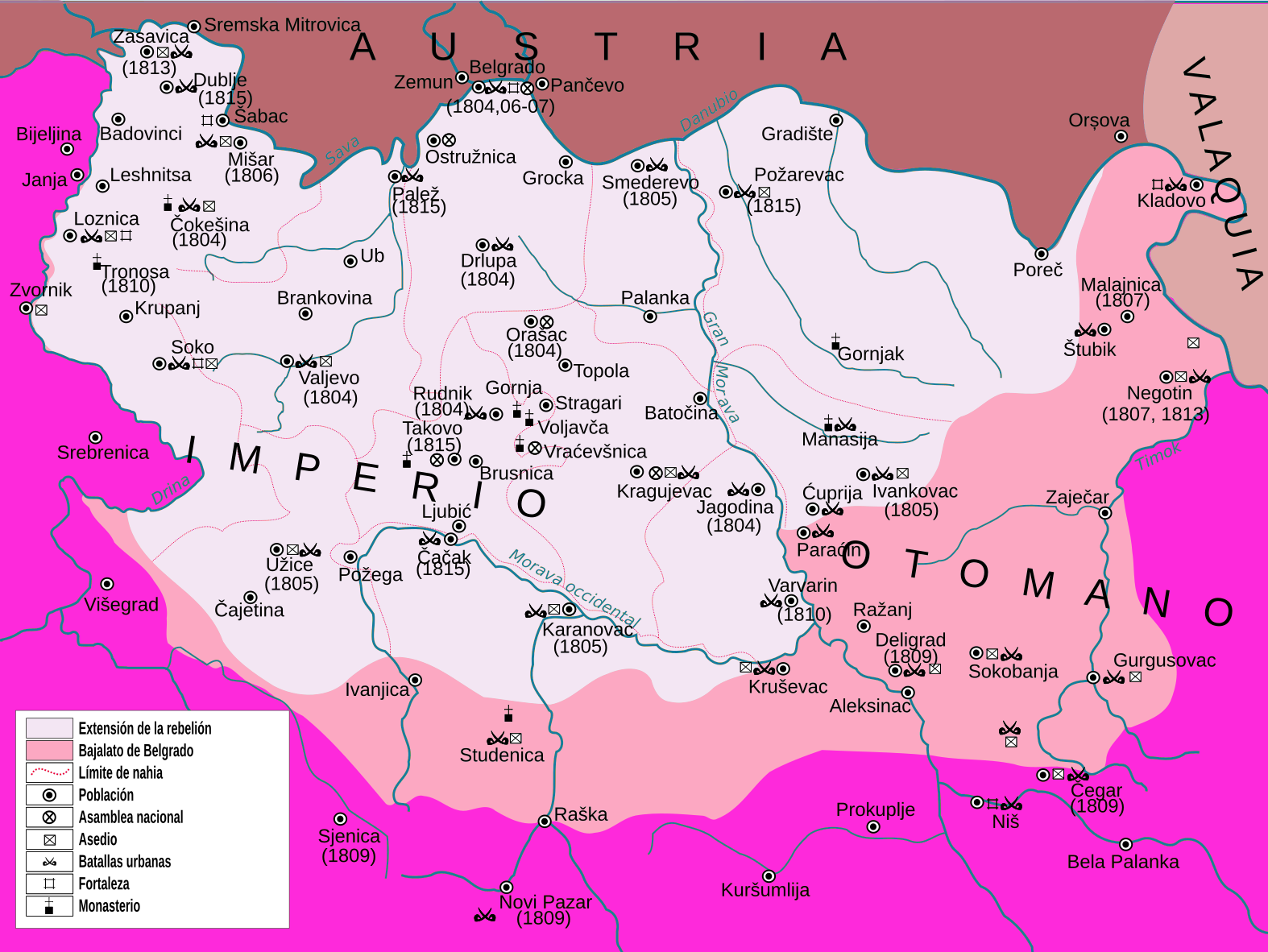
Karadjordje and the First Serbian Uprising (1804-1813)
Djordje Petrovic, better known as Karadjordje was a Serbian revolutionary leader who fought for his country's independence from the Ottoman Empire during the First Serbian Uprising of 1804–1813.
Born into an impoverished family in the Šumadija region of Ottoman Serbia, Karadjordje distinguished himself during the Austro-Turkish War of 1788–1791 as a member of the Serbian Free Corps, a militia made up of Habsburg and Ottoman Serbs that was armed and trained by the Austrians. Fearing retribution following the Austrians' and Serb rebels' defeat in 1791, he and his family fled to the Austrian Empire, where they were to live until 1794, when a general amnesty was declared. Karadjordje subsequently returned to Šumadija and became a livestock merchant. In 1796, the rogue governor of the Sanjak of Vidin, Osman Pazvantoğlu, invaded the Pashalik of Belgrade, and Karadjordje fought alongside the Ottomans to quash the incursion.
The janissary commanders murdered the Ottoman Vizier Hadži Mustafa Pasha of Belgrade in 1801 and occupied the sanjak, ruling it independently from the Sultan. Tyranny ensued. The janissaries suspended the rights granted to Serbs by the Sultan earlier, and increased taxes, and imposed forced labor, among other things. The janissaries feared that the Sultan would use the Serbs against them, so they murdered more than 70 Serbian chiefs between 23 and 29 January 1804.
On 14 February 1804, in the small village of Orašac near Aranđelovac, leading Serbs gathered and decided to begin an uprising, choosing Djordje Petrović as their leader. The Serbs, at first technically fighting on the behalf of the Sultan against the janissaries, were encouraged and aided by Ottoman cavalry corps.
For their small numbers, the Serbs had great military successes, having taken Požarevac, Šabac and charged Smederevo and Belgrade, in quick succession. In july the janissary commanders fled east to Ada Kale, an island on the Danube. They refused to surrender, and were captured and beheaded, on the night of 5–6 August 1804.
The Sultan, fearing of the serbs power, ordered all pashaliks in the region to crush them. The first major battle was the Battle of Ivankovac in 1805, in which Karadjordje defeated the Turkish army and forced it to retreat toward Niš. The Serbs established a government and parliament that returned the land to the people, abolished forced labor and reduced taxes.
The second major battle of the uprising was the Battle of Mišar in 1806, in which the rebels defeated an Ottoman army from the Eyalet of Bosnia led by the Turkish Sipahi Suleiman-Pasa. Serbian rebels then joined the Russians as their allies in the Russo-Turkish War. The Battle of Deligrad in December 1806 provided a decisive
victory for the Serbs and bolstered the morale of the outnumbered rebels. To avoid total defeat, Ibrahim Pasha negotiated a six-week truce with Karadjordje. By 1807 the demands for self-government within the Ottoman Empire evolved into a war for independence backed by the military support of the Russian Empire.
Following the successful siege with 25,000 men, on 8 January 1807 Karadjordje proclaimed Belgrade the capital of Serbia.
In March 1809 Hurşid Paşa was sent to the Sanjak of Smederevo to put down the revolt. The diverse Ottoman force included vast numbers of soldiers from many nearby Pashaliks. On 19 May 1809 3,000 rebels led by commander Stevan Sinđelić were attacked by a large Ottoman force on Čegar Hill, located close to the city of Niš.
In a desperate situation, and not wishing for his men to be captured and impaled, Sinđelić fired into his entrenchment's gun powder magazine resulting in an explosion that killed all the rebels and Ottoman troops in the vicinity. Afterward, Hurshid Pasha ordered that a tower be made from the skulls of Serbian revolutionaries. Once complete, the ten-foot-high Skull Tower contained 952 Serbian skulls embedded on four sides in 14 rows. The Serbian defeat at Čegar Hill meant the loss of initiative in the war.
In August 1809 an Ottoman army marched on Belgrade, prompting a mass exodus of people across the Danube. Facing disaster, Karadjordje appealed to the Habsburgs and Napoleon, with no success.
With the reestablishement of Ottoman control, many of the revolutionaries, around a quarter of the population, including Karadjordje, fled to the Habsburg Empire. Recaptured by the Ottomans in October 1813, Belgrade became a scene of brutal revenge, with hundreds of its citizens massacred and thousands sold into slavery. Direct Ottoman rule also meant the abolition of all Serbian institutions and the return of Ottoman Turks to Serbia.
Despite Ottoman requests for his extradition, the Austrians handed Karadjordje over to the Russians, who offered him refuge in Bessarabia. There, he joined the Greek secret society known as Filiki Eteria, which planned to launch a pan-Balkan uprising
against the Ottomans. Karadjordje returned to Serbia in secret in July 1817, but was killed shortly thereafter by agents of Miloš Obrenović, a rival rebel leader, who was concerned that Karadjordje 's reappearance would cause the Ottomans to renege on the concessions that they had agreed to following the Second Serbian Uprising of 1815.
Subscribe to:
Posts (Atom)